Is beauty a shield?

Or is it a curse?

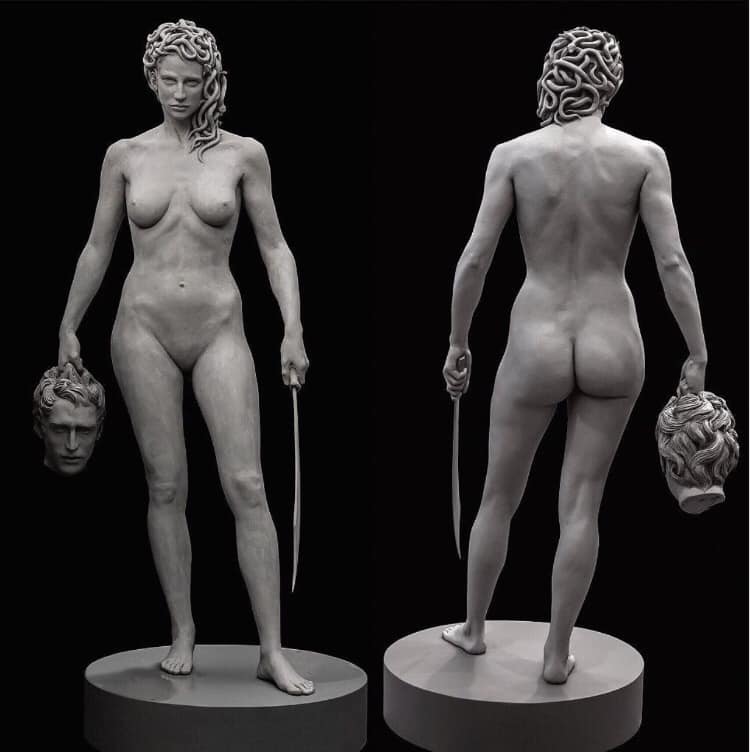
I want to go after the predators. (“Medusa” by Luciano Garbati)

I have always envied beautiful women. What’s it like to glide through the world, with doors (literally) opened for you? What’s it like to (I assume) like what you see in the mirror and not to hate the camera? What’s it like to know that you have the one currency that is valued in women?

And then I read what happened to Paulina Porizkova.

When she was 15 years old.

I don’t know about you, but I had barely kissed a boy when I was 15. I had seen my brother naked, but I was not in the habit of seeing the penises of men I didn’t even know. Or even of the ones I did know.

In my world, men did not show their penises to teenage girls.

In this excerpt (from her book) below, Porizkova is having her makeup done at one of her first photo shoots.

I watched in the mirror as the photographer sidled up behind me and placed something warm and yielding on my shoulder. I kept smiling. The thing on my shoulder looked like a large brown flower in the reflection, and I got a whiff of something food-​­like, soup-​­like. A soft, heavy pretzel? Pantyhose stuffed with mashed potatoes? The room was silent except for the pop of an umbrella flash followed by a high-​­pitched whine as the photo assistant tested the equipment nearby. The makeup artist moved aside a little and laughed. Her laughter assured me this was funny. I joined in, giggling, although I had no idea what I was laughing at.

I kept staring at myself and this odd thing in the mirror. My shoulder was at the same height as the photographer’s crotch. Finally, I turned my head to look at it directly and realized it was attached to his body. Attached to the part of his body where a penis would be. It rested there, casually, nestled between my collarbone and the side of my neck. I looked back at us in the mirror.

He grinned at me as if this was a fun little joke. The makeup artist shook her head lightly and raised her eyebrows, as if to say, “Here he goes again!”

I had seen photos and illustrations of penises in health and biology classes at school, but I had never seen a real penis before, and certainly not one held up right next to my face. Could it be?

I wanted to jump up and get away from it. But with another woman laughing, I thought my impulse must be wrong. Her laughter made the whole thing seem … lighthearted. Inconsequential. Like I’d ruin the fun if I didn’t laugh along. I kept smiling. I needed them to like me.

It wasn’t until he retracted that thing on my shoulder, stuffed it back in his pants, and zipped up that I knew for certain that, yes, it really, actually had been his penis.

Paulina Porizkova, The Cut

Nobody came to her aid.

Nobody told the man to knock it off.

Nobody protected her.

I know it was the ’70s, but even back then, it was not, I am pretty sure, socially acceptable or work acceptable to put your penis on the shoulder of a teenage girl.


I don’t have an answer. I don’t know what to say to the man who put his penis on the shoulder of a girl he didn’t know or to the people who enabled him. I don’t know what we do. I wish she had named names. But even if she did, would shame work? Some men are beyond shame.

I leave you with an insta post where Porizkova describes what it’s like to be beautiful but still think you don’t measure up.

My friend is beautiful

She knows because her grandmother and mother told her

(This post isn’t really about feet. But these shoes are awesome.)

Years ago, my friend Shayna and I were at the pool with her grandparents and her mom. Shayna was sitting on the edge of the pool, dangling her feet in the water.

Her grandmother lifted Shayna’s foot and stroked it, saying, “Have you ever seen such a beautiful foot? Shayna, you have the most beautiful feet I have ever seen! Mimi, look at your daughter’s feet. Aren’t they gorgeous?”

Shanya’s mom waded over, looked at Shayna’s foot, and agreed with Shayna’s grandmother. The two of them raved about Shayna’s feet for another minute while Shayna sat there, soaking it in and accepting the praise as if it was something she had heard every day of her life.

Which may have been the case.


I told this story to a friend.

After a long pause, she asked, “People grow up that way? People have parents and grandparents who lavish praise on them?”

“I know!” I laughed. “I know!”


I come from a long line of non-praisers. They were not praised, so they never learned how to praise.

I’m sure this does not make me unusual.

Indeed, I have read that the northern European child-rearing practice has been not to praise kids because you don’t want them to become arrogant. “Don’t want them to get a swelled head” is what I remember seeing.


Shayna had an ease and a confidence in her body that I have never had.

When we were in grad school, she pulled at her waistband and said she had gained some weight during her part-time waitressing job.

Then she shrugged and said, “I need to stop eating the maraschino cherries at work. Turns out they have a lot of calories.”

And that was it. That was the extent of her distress over having gained a little bit of weight. She wasn’t concerned.


She was also confident about her intellectual abilities.

I, too, am confident about mine, but that’s because there are many sources of validation about our brains. We get good grades, we do well at work. We don’t need people to tell us we are smart.

But about our bodies? Growing up? Whom do we trust to give us feedback on our bodies?


My influences as a kid were Seventeen magazine, the covers of McCall’s, Vogue, and Butterick patterns, and General Hospital.

In these, I saw thin, sometimes Black but mostly White, beautiful women.

Thin.

Beautiful.

Completely unattainable.

And there was nothing to tell me that looking like an ordinary girl or teenager was OK.

All I knew was I didn’t look like any of the women I saw in the media.


Shayna also did not look like the women in the media (now we know that neither do the women in the media), but she had reinforcement from other places. She had people telling her that her feet were beautiful.

Her feet.

If she had people she trusted telling her at age 33 that her feet were beautiful, my guess is that they had also been telling her since the day she was born that her elbows were beautiful. That her knees were beautiful. That her stomach was beautiful. That her thumbs were beautiful. That her everything was beautiful. That she was beautiful.

The people she trusted gave her the armor she needed to face the world.


I don’t want women to think their only worth is in how they look. Beauty <> value.

But I also can’t ignore reality.

If someone knows – because the people she loves and trusts have told her – that she has beautiful feet and beautiful hands and beautiful elbows and beautiful everything, that’s one less battle she has to fight.

Nobody likes me

(Turns out that’s probably not true)

I’m torn between the desire to make friends and the desire to stay at home and read.

Usually, I choose reading.

But when I do want to make friends (the research shows that people with strong social networks are both happier and healthier and who doesn’t want to be happier or healthier?), I’m not sure how to do it.

I didn’t know how when I was a kid – you would think changing schools ten times before graduating from high school would have taught me but it didn’t – and I don’t know how now.

I do know, however, that Mr T’s approach might not be the right way.

Me: Spouses really aren’t supposed to rely on each other for all their friendship needs.

(I’m making that up, but it makes sense, right?)

Me: Isn’t there anyone around here you would like to be friends with?

Mr T: I’d like to hang out with Sergio.

Me: Then why don’t you?

Mr T: He’s busy! He has a job and he’s in a band and he has a little kid.

Me: He lives one block away and you could sit in the driveway and have a beer. Do you ever ask him that?

Mr T: Sure I do! Almost every time I run into him, I say we should have a beer together.

Me: And?

Mr T: And what?

Me: And then what?

Mr T: What do you mean?

Me: Do you suggest a time?

Mr T: No. I figure he’s the one with the busy schedule.

Me: Ha. When people do this to me – when they say “We should get coffee!” and then don’t follow up, I take it as they expect me to do all the work. If someone suggests getting together, I expect her to take the next step and propose a date.

Mr T: Oh. I hadn’t thought of it that way.

Me: I have friends who have thanked me for being the one who invites, which I don’t mind. If I see something I’d like to do, I don’t mind suggesting it. But if the other person brings up an activity, she should be the one who does the work to arrange it. And if she is always tossing out a general “We should get together sometime!” but never actually proposes a specific time, I assume she really doesn’t want to get together.

Mr T: Maybe.

Me: Maybe you need to be the one to say “Want to come over tomorrow after work and have a beer?”

Mr T: Maybe.


Guess what?

I’m probably wrong that the person who suggests without proposing doesn’t actually want to get together. They probably are not empty words at all.

But the person who says “Let’s have lunch!” and then never sets anything up might not have read Dr Marisa Franco‘s new book, Platonic.

Dr Franco, whose field of research is friendship, explains how to make friends. If you don’t want to read the book, listen to the podcast below. Even the first ten minutes are worth it.

Here’s a summary:

  • Put yourself around people
  • Talk to them
  • If you have a spark with someone, say, “You seem cool! Want to get coffee sometime?”
  • If they say yes, then set up a time

She also says that people like you more than you think they do. I always assume that I am bothering people and that they have better things to do to talk to me, but maybe that’s not true?

And to stop avoiding people, either by not going out at all or by hiding in the corner with the cats when you go to a party. OK, she said with the dog, but I would never choose a dog over people. A cat, yes. A dog, no.


Mr T and I are both going to try. He is going to invite his friend over on a specific date.

And the next time someone tells me that we should get together, instead of getting cranky that she doesn’t take the next step, which is my preference, I am going to take a deep breath and propose a date myself.

God forgives you but I do not

(And I’m pretty sure that the people I do not forgive aren’t asking God, either)

“For the times you tricked me/For the children you didn’t give me/The promises you didn’t keep/The kisses you didn’t seek….God forgives you/But I do not”
Diana Navarro

There are people in my life I will never forgive.

Some things are unforgiveable.

Especially when the people who have wronged you don’t ask for forgiveness.

I will never forgive Mr T’s parents for telling him not to marry me, then telling him that they would not come to our wedding (which was actually fine with me), and relenting only when he told them I was pregnant and that if they did not come to the wedding, they would never see their grandchild.

I will never forgive them for disinheriting him yet dumping all the (very messy) estate and trustee work on him.

I will never forgive Mr T’s brother for accusing him of stealing from our disabled nephew’s trust.

I will never forgive Mr T’s brother for screaming at him for not reimbursing him $800 cash for the frequent flyer miles he used to attend their father’s funeral.

I will never forgive because these people never asked for forgiveness.

They never said they were sorry.

They never changed their behavior.

I never forgave and I never will forgive and I am happy to have cut them out of my life.

It works for me.


There are people who have been taught that they have to put up with this kind of treatment.

There are people who have been taught that being a good Christian means that no matter what kind of abuse someone dishes out, you have to take it.


My friends, Jesus never said you had to put yourself in situations where you were going to be abused.

He never said that even though you know people are going to be mean to you, you still have to be around them.

Indeed, he was the master of subversive resistance.

That whole “turn the other cheek” thing?

Look it up. It’s all about social status and how people slapped each other back then. Turning the other cheek was basically forcing Regina George to let you sit with her at lunch.


I have a friend, whom I love deeply, who has told me that I should forgive Mr T’s parents and his brother. When I tell her stories about the parents and brother, she does not want to hear them. She says I need to put that behind me, even though the brother is still around and still causing trouble and even though part of the way we put things behind us is by telling the stories.

She tells me to forgive.

She does not think I should cut them out of my life.

She does not think I should get to avoid people who make me unhappy.

All I want is for her to tell me that I’m right and that these people are awful.

But then I remember that she was raised and still lives in a very conservative community.

I remind myself that she grew up in a different world. Who would *choose* a world where you have to be around jerks?

My heart breaks for her as I think about how much pain she must have in her life. How many times has she been forced to grit her teeth and endure the company of people who have hurt her? How many times has she been told that the only way to be a good person – to be a good woman? – is to “forgive” the person who wronged her? How many times has she been forced to squelch her own wishes?

And I exhale.

And I forgive her. I forgive her for not listening to my stories. For not telling me I’m right and that these people are awful. And I give her a hug for all the pain in her life and wish it could have been different for her.